
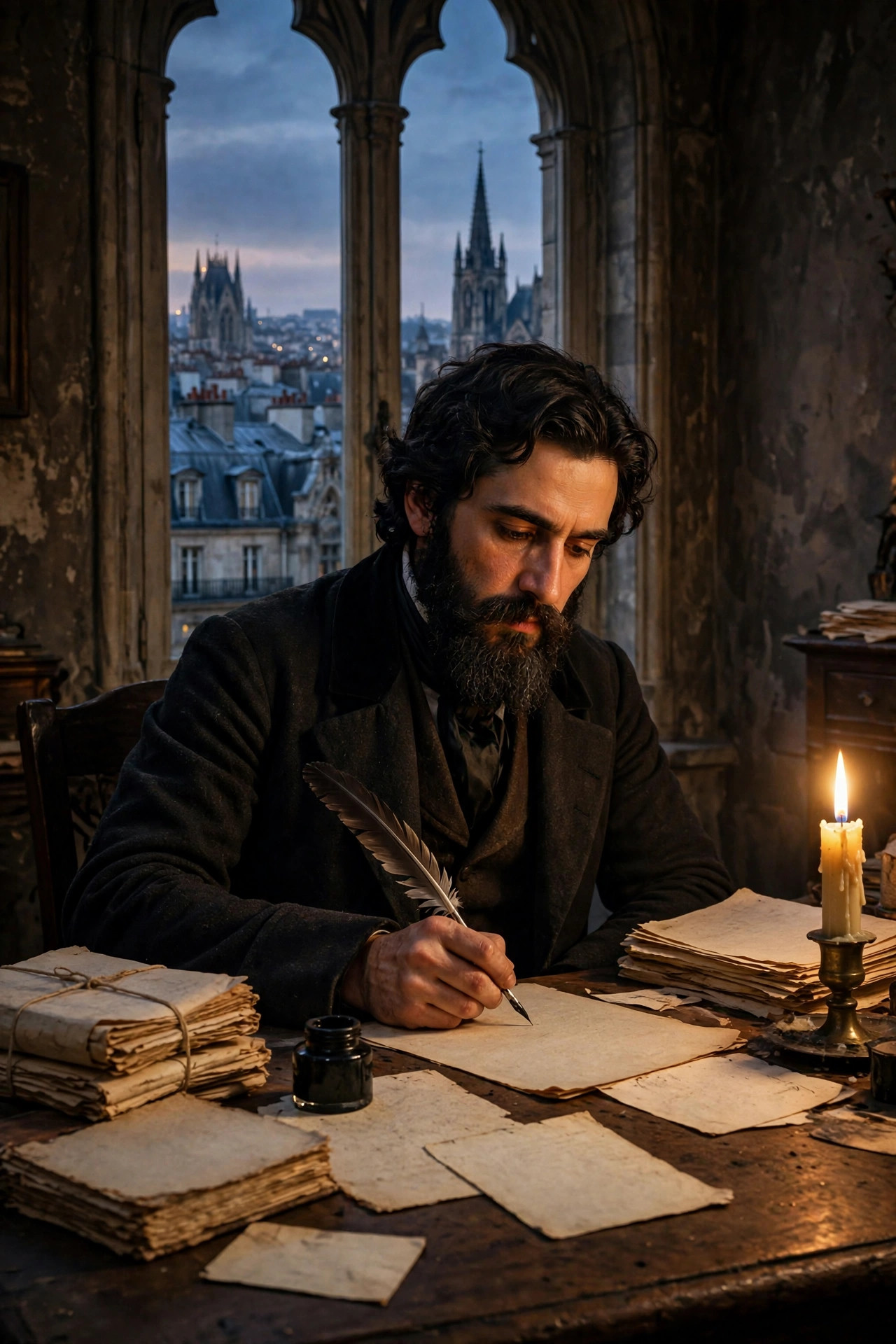
Victor Hugo was one of the most important writers France ever produced. His novels, plays, and poems shaped French literature and influenced readers around the world. Two of his books, The Hunchback of Notre-Dame and Les Miserables, became global classics that are still read and adapted today.
But Victor Hugo was more than a novelist. He was also a poet, a playwright, and a political voice who spent nearly twenty years in exile for his beliefs. His life was as dramatic as his fiction. This is the story of Victor Hugo, from his childhood in France to his place in the Pantheon.
Early Life And Rise To Fame
Victor Hugo was born on February 26, 1802, in Besancon, France. His father was a general in Napoleon’s army, and his mother came from a royalist family. The family moved often during his childhood before settling in Paris. He showed a gift for writing early. In 1817, at the age of fifteen, he earned an honorable mention from the French Academy for a poem.
His first poetry collection, Odes, appeared in 1822, the same year he married Adele Foucher. The book brought him a royal pension from King Louis XVIII. Victor Hugo soon became the leader of the Romantic movement in France. His play Hernani premiered in 1830, and the stormy opening night became known as the Battle of Hernani. It marked the triumph of Romanticism over strict classical rules.
The Novels That Made Him Famous
Victor Hugo published The Hunchback of Notre-Dame in 1831. The novel is set in medieval Paris and tells the story of Quasimodo, the deformed bell ringer of the cathedral, and Esmeralda, the gypsy dancer he loves. It was an instant success. The book also helped spark public interest in preserving the Gothic architecture of France.
His greatest novel, Les Miserables, was published in 1862. It follows Jean Valjean, an ex-convict trying to build an honest life, and Inspector Javert, the policeman who relentlessly hunts him. Victor Hugo worked on the book for many years. Hugo wrote it partly in response to the poverty and injustice he saw around him in France. It became one of the most successful novels of its time, and later stage and film adaptations introduced his work to new generations.
Exile From France
Victor Hugo was a passionate supporter of the French Republic. When Napoleon III seized power in a coup in 1851, Hugo spoke out against him and was forced to flee the country. He first went to Brussels, then to the island of Jersey, and finally settled on Guernsey in the Channel Islands. He would remain in exile for nineteen years.
Exile did not silence Victor Hugo. He wrote some of his most powerful works on Guernsey, including Les Miserables. He lived in Hauteville House, a home he decorated himself, which still stands today as a museum. He refused every offer of amnesty until Napoleon III lost power.
Return And Later Years
Victor Hugo returned to France in 1870 after the fall of Napoleon III. He was welcomed back as a national hero and served in the National Assembly and later the Senate. He kept writing poetry and campaigned for causes such as free public education and the abolition of the death penalty.
Hugo died in Paris on May 22, 1885, at the age of eighty-three. His funeral drew enormous crowds, and he was buried in the Pantheon alongside other national heroes of France. The French government declared a day of national mourning for him.
Why Victor Hugo Still Matters
The legacy of Victor Hugo reaches far beyond literature. His writing gave a voice to the poor and the oppressed. His characters, from Quasimodo to Jean Valjean, remain cultural icons around the world. He was also one of the leading moral voices of his century, fighting for human rights and social justice.
Streets, squares, and schools across France carry his name. Today, Victor Hugo is remembered as the central figure of French Romanticism and one of the greatest writers in history. His books are still translated, filmed, and performed across the globe. More than a century after his death, the name Victor Hugo stands for compassion, courage, and the power of words.